Florida’s citrus industry has lost nearly everything it once poured into the nation’s juice glasses. Production dropped 94 percent between the 2003 and 2023 seasons. The counts come from the U.S. Department of Agriculture’s National Agricultural Statistics Service, reported by the University of Florida Emerging Pathogens Institute. The industry that once led the world in oranges now runs on a fraction of itself.
The collapse has a name: citrus greening, or huanglongbing. The bacterial disease surfaced in South Florida in 2005, seven years after the insect that carries it arrived in the state, and it has since reached nearly all of Florida’s citrus production regions. This connects to our earlier piece, A Guide to Florida's State Parks Worth the Drive From Miami.
What Is Citrus Greening and Why Is There No Cure?
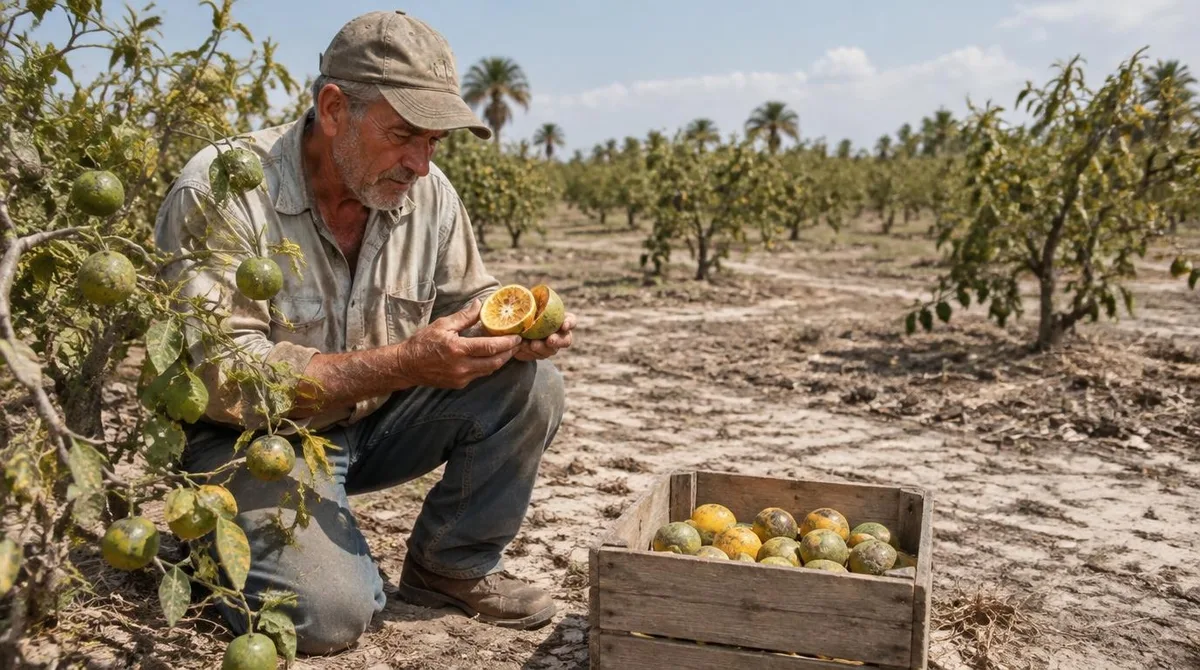
Citrus greening is caused by a bacterium called Candidatus Liberibacter asiaticus. It travels by way of the Asian citrus psyllid, a sap-sucking insect native to Asia. The infection weakens a tree’s vascular system and limits the flow of nutrients. The tree slowly declines. Once a tree is infected, it gradually produces unviable and unpalatable fruit before becoming unproductive. Newly planted saplings can fail within three to five years of exposure, according to the Emerging Pathogens Institute.
The disease also hid for years in plain sight. Early symptoms resemble common nutrient deficiencies, with mottled leaves and yellow shoots, which slowed recognition of the threat in the groves.
How Large Was the Industry at Its Height?
Florida long stood as the largest orange-producing state in the country and the third largest orange producer in the world, behind only Brazil and China. About 95 percent of the state’s oranges went into juice, according to a University of Florida Institute of Food and Agricultural Sciences analysis. The analysis cites a 2015 federal tally. Grove care, picking crews, juice plants and trucking lines all grew around that crop.
The trade carried weight beyond the groves. Orange juice held a fixed place on American breakfast tables. Counties around the state’s central ridge built economies on the fruit. That is the base from which the decline is measured.
Where Did the Disease First Surface?
The outbreak began in South Florida, the region that includes Miami-Dade County. The University of Florida’s citrus research program records the discovery there in 2005. The Asian citrus psyllid had already been in the state since 1998, so the bacteria had a ready ride from tree to tree. The disease has since spread to nearly all production regions in the state, the program reports.
The disease is not new to science. First described a little over a century ago, huanglongbing counts as one of the oldest known citrus diseases. Its common name came from Chinese researcher Lin Kung Hsiang in 1956, and it translates as yellow dragon disease.
How Deep Is the Decline Today?
The arithmetic is stark. Federal counts show Florida citrus production down 94 percent between the 2003 and 2023 seasons. More than 90 percent of acres in a typical citrus operation are affected, and more than 80 percent of trees are infected, according to the Emerging Pathogens Institute. There is no cure for citrus greening.
Control efforts lean mainly on insecticides aimed at the psyllid, the institute notes, while growers and researchers search for tolerant trees and a lasting answer. University of Florida economists have tracked the costs across the state, from lost yield and smaller fruit to higher bills and rising tree mortality. Readers following this should also see Roughly 140 New Florida Laws Took Effect July 1 Across the State.
Conclusion: The Yellow Dragon and the Grove Towns
The name still tells the story. Lin Kung Hsiang called the disease the yellow dragon in 1956, and for Florida the dragon has been feeding for two decades, taking the state from the top of world orange production to a small fraction of itself.
What remains is stubborn. Most of the oranges Florida still grows end up as juice, so the state’s slow decline arrives first at breakfast tables. The trees that remain stand in groves far smaller than their grandparents knew. The people who tend them wait on science to catch up with a disease that arrived seven years after the bug that carries it.