Urban Paradise Guild, the volunteer-run nonprofit whose Amelia Garden Center anchors its urban agriculture work in Liberty City, has been growing food and native habitat in the neighborhood since March 2009, per the organization's own program page. The group's garden centers span roughly 6.5 acres across Miami, and the Liberty City site functions as both a working garden and an outdoor classroom: Saturday volunteers plant, weed, harvest and learn, and the produce supports the organization's food-access work in a neighborhood the county's own food-insecurity mapping marks as underserved.
What is the Urban Paradise Guild?
The Guild is a Miami nonprofit built almost entirely on volunteer labor, organized around restoring natural habitats and growing food inside the city. Its program pages describe work streams that run from coastal dune and pine rockland restoration to urban agriculture, and its Liberty City garden work — the Amelia Garden Center — began in March 2009 and has expanded gradually as land, tools and volunteer capacity allowed, per the organization. Unlike a community garden where members rent individual plots, the Guild's model is communal: volunteers garden together, and the harvest flows to the neighborhood rather than to a membership roster.
The organization's scale is modest and its method is patient. A typical project starts with a vacant or underused lot, a compost pile and a small crew; beds, fruit trees and native plantings accumulate season by season. The Guild's materials describe garden centers as resource hubs — places where residents can get seedlings, compost, advice and, above all, a place to work with their hands.
Why Liberty City?
The neighborhood's need and its land converge. Liberty City sits in one of Miami-Dade's documented food-desert zones, where full-service groceries are scarce and fresh produce scarcer, and its blocks hold the vacant lots that urban agriculture requires. Community food projects in the neighborhood — the Guild's gardens among them — treat growing as both nutrition and occupation: food produced blocks from where it is eaten, by the people who will eat it.
The choice also connects to the neighborhood's history. Liberty City's Boom-era subdivisions left a grid of generous lots, and the neighborhood's long experience of disinvestment left the open land that gardens occupy. Every bed planted on a vacant lot is, in the Guild's framing, a temporary claim on land that could return to the market — gardens tend the soil while they have it.
What happens on a volunteer Saturday?
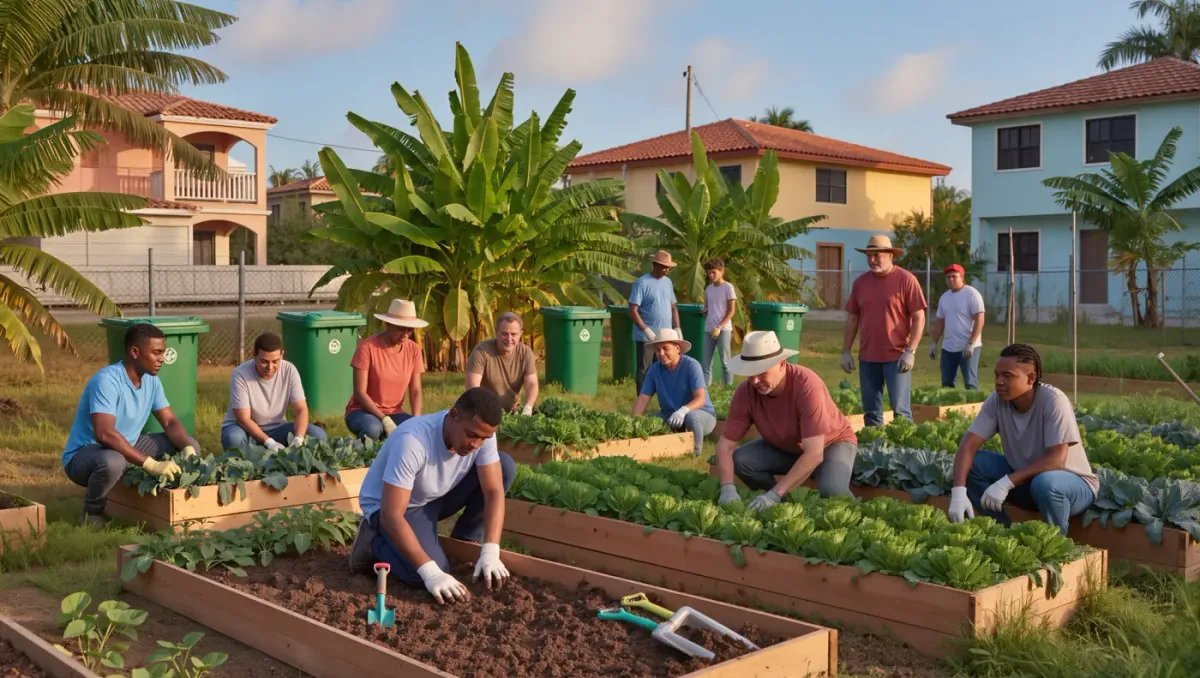
The work matches the season. Volunteers arrive on weekend mornings, sign in with a crew leader, and cycle through the day's tasks: turning compost, weeding beds, planting seedlings of okra, collards, callaloo and tropical spinaches suited to Miami's climate, mulching fruit trees, and harvesting whatever is ready. No experience is required — the organization's pages invite beginners — and tools, gloves and drinking water are provided on site. Families, students completing service hours and retirees make up the regular crews, and shifts typically run two to three hours.
- Planting and harvesting vegetables suited to South Florida's two growing seasons.
- Compost management, the engine of the garden's soil.
- Native and fruit-tree plantings that double as habitat restoration.
- Workshops on home growing for residents who want to start their own beds.
How does the food reach the neighborhood?
The Guild's urban agriculture program distributes harvests through the organization's own food-access efforts and through partners in the neighborhoods where it gardens, per its program materials. The volume is honest about its scale: a volunteer garden feeds dozens, not thousands. Its advocates argue, with a decade and a half of harvests behind them, that the deeper returns are educational — residents who watch a collard bed for a season learn what Miami's climate actually grows, and when — and practical, since seedlings and compost from the garden centers go home with volunteers to start kitchen-garden beds of their own.
The county's extension service, UF/IFAS Extension Miami-Dade County, provides the research backbone for this kind of growing in South Florida, from tropical vegetable varieties to soil testing, and community gardens across the county rely on its guidance.
What do the garden's neighbors say the work changes?
The measurable outputs — pounds of produce, beds planted — sit beside less countable ones the Guild's volunteers describe: a vacant lot that drew dumping now draws foot traffic, teenagers who arrive for service hours leave knowing what a healthy soil ball feels like, and the Saturday crews double as the neighborhood's most reliable early-warning network for seniors living alone nearby. Community gardens in food-desert census tracts have been studied for exactly these second-order effects, and the Liberty City site fits the pattern the research describes: modest harvests, larger social returns.
How can residents get involved?
Volunteer sign-ups run through the Guild's website, and the Liberty City garden's Saturday sessions welcome drop-ins who confirm the schedule first, since work mornings shift with weather and season. Residents can also contribute by donating tools, composting materials and fruit trees, or by proposing a new garden site — the organization's expansion model starts with a resident who has eyes on a lot. As of 2025, the Guild's Liberty City work marked more than fifteen years since that first garden season began in March 2009.
The harvest from a Saturday in Liberty City is measured in beds planted and neighbors taught. In a neighborhood where grocery access remains a mapped and measured problem, the Guild's answer grows a row at a time.