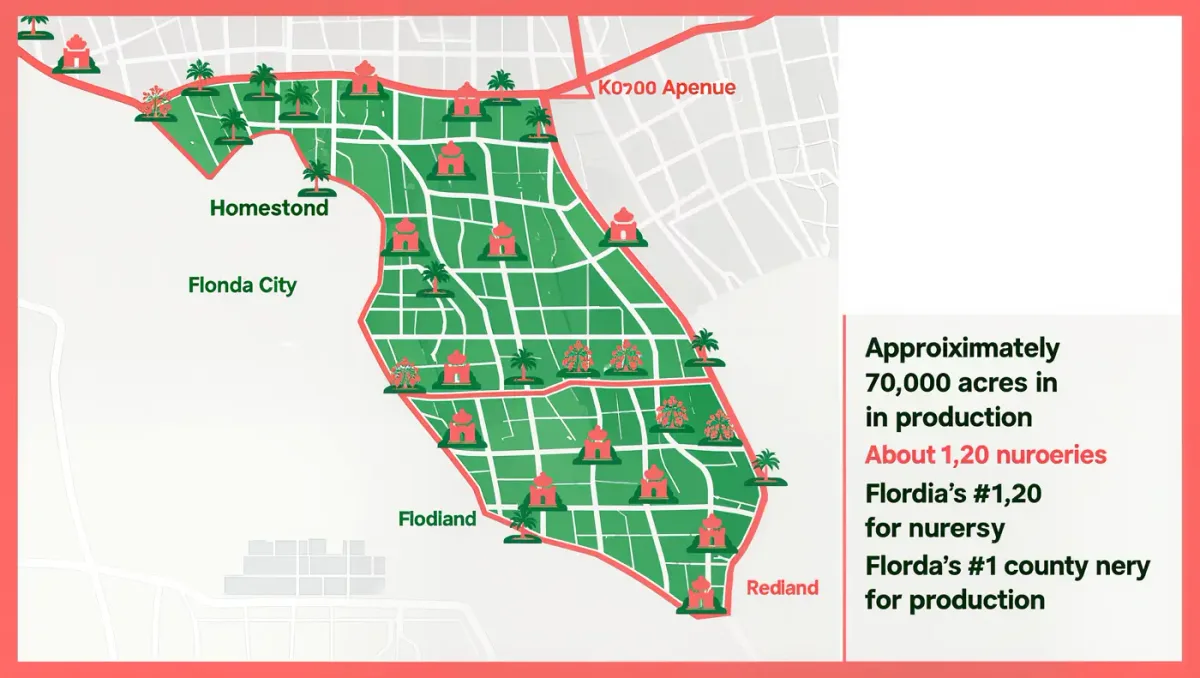
The largest crop business in Miami-Dade County is not a fruit — it is ornamental plants. The county ranks first in Florida in nursery and ornamental production, working roughly 70,000 acres of production concentrated in the Redland agricultural district south of Homestead, per USDA figures cited by the South Dade News Leader, within a Florida nursery industry the University of Florida values at $31.4 billion in economic impact. For visitors and new businesses, the nurseries, farm stands, and agritourism operations of South Dade form a working economy that most of the county never sees.
What grows in the Redland?
The Redland — the unincorporated agricultural belt between Homestead, Florida City, and Everglades National Park's eastern edge — runs on ornamental nursery stock: tropical garden plants, palms, orchids, anthuriums, and foliage grown in shaded acre-square fields and shipped to planting contractors and retailers across the eastern United States. Row crops and tropical fruit — mangoes, avocados, lychees — share the ground, but ornamentals carry the volume. The county holds an estimated 1,200 nurseries, many family operations on former row-crop land, per UF/IFAS reporting.
Can visitors tour the nurseries?
Some, yes — and the county has formalized the option. In 2024, Miami-Dade created an agritourism district for the Redland allowing property owners to convert up to 2.5 acres, about 5 percent of a 20-acre parcel, to agritourism use, per WLRN reporting on the commission's decision. Working nurseries host sales days and seasonal events, and the surest public anchor is Fruit & Spice Park at 24801 SW 187th Avenue, a 37-acre county park growing more than 500 varieties of tropical fruit, spices, and herbs, with guided tours and a tasting-focused program year round. The Redland Market Village strip along Krome Avenue adds weekend farm-stand traffic.
When is the best time to visit?
The winter and spring dry season, roughly December through April, is peak: mango and avocado trees carry fruit through late spring, orchid sales events cluster around spring, and the summer heat thins both crowds and inventory. Hurricane season, June through November, is the trade's hard season — a named storm can flatten shade houses across the district, as growers have repeatedly documented — so late-season visits may find operations rebuilding. The annual Tropical Ag Fiesta, hosted in Homestead, gathers the district's growers under one roof each June, and the Redland's country festivals through the winter months put farm gates open to the public on practically every weekend calendar. Visitors should treat the district as a day trip: distances between growers run in miles, not blocks, addresses resolve to locked gates and honor-system stands, and the compact between the public and a working agricultural zone depends on visitors staying on the public side of it.
What does the nursery trade mean for South Dade's economy?
It is the district's payroll. Nursery work sustains year-round employment across the Homestead and Florida City communities, feeds the county's packing and trucking economy, and holds the urban development boundary where it is — the ornamental trade's profitability is a working argument for the agricultural zoning that keeps the Redland rural. The county ranks second in Florida in overall farm production value, per Miami-Dade's agriculture office, and nurseries supply a large share of that standing. Pressures are real: farmland acreage has declined across successive USDA agricultural censuses, and development pressure from Miami's growth keeps testing Krome Avenue's western edge.
Who buys from the nurseries?
The customer list explains the district's scale. Planting contractors across Florida and the Southeast buy Redland-grown palms, shrubs, and groundcover for developments and streetscapes; big-box garden centers restock from the same fields; interior-foliage dealers ship the district's tropicals to offices and malls as far north as Canada; and the orchid houses sell to wholesalers and to the public at weekend events. The district's output is measured in truckloads, not bushels, and its logistics run on the same grid of county roads visitors drive. Wholesale buyers order ahead by season, and the largest nurseries operate propagation houses where the next crop is already rooted before the current one ships.
What pressures does the district face?
Land, labor, and disease. Farmland acreage in the county has declined across successive USDA agricultural censuses, and every session of the county commission brings proposals that test the Urban Development Boundary along Krome Avenue — the line that keeps the Redland rural and the nurseries legal to operate. Labor costs and housing costs for the district's workforce climb with the region's. Plant disease is the quiet one: the University of Florida's extension service has documented the need for more research into the pathogens moving through Miami-Dade's ornamental stock, and a single outbreak can set a nursery back a full growing cycle. Growers answer with shade-house investment, tighter propagation stock, and the industry associations that represent the district in Tallahassee and at county hall.
What grows here besides ornamentals?
More than the county's ranking suggests. The Redland's fields produce tropical fruit — mangoes and avocados above all, plus lychee, longan, guava, and the mamey sapote that Miami's batido counters blend — alongside winter vegetables that historically made South Dade one of the country's key wintertime vegetable suppliers. Beekeeping, aquaculture, and specialty herb operations share the grid, and the district's farm stands sell the harvest directly along Krome Avenue and Quail Roost Drive. The ornamental trade may lead the payroll, but the fruit economy gives the district its public face: the mango festivals, the avocado season, and the U-pick operations that draw county residents south every summer.
How does a buyer work with a Redland nursery?
Most wholesalers sell trade-first, but many open retail hours to the public, and the practical route is direct contact: growers list through the county's agriculture office and industry associations, prices move with the season, and bulk planting orders are negotiated on-site. Buyers driving the district's grid — SW 187th Street, 192nd Avenue, and the roads between — should respect private property signs; the fields are workplaces, not parkland.
The USDA's Census of Agriculture county data sit at nass.usda.gov, and the University of Florida's IFAS extension publishes its nursery-industry research at blogs.ifas.ufl.edu.