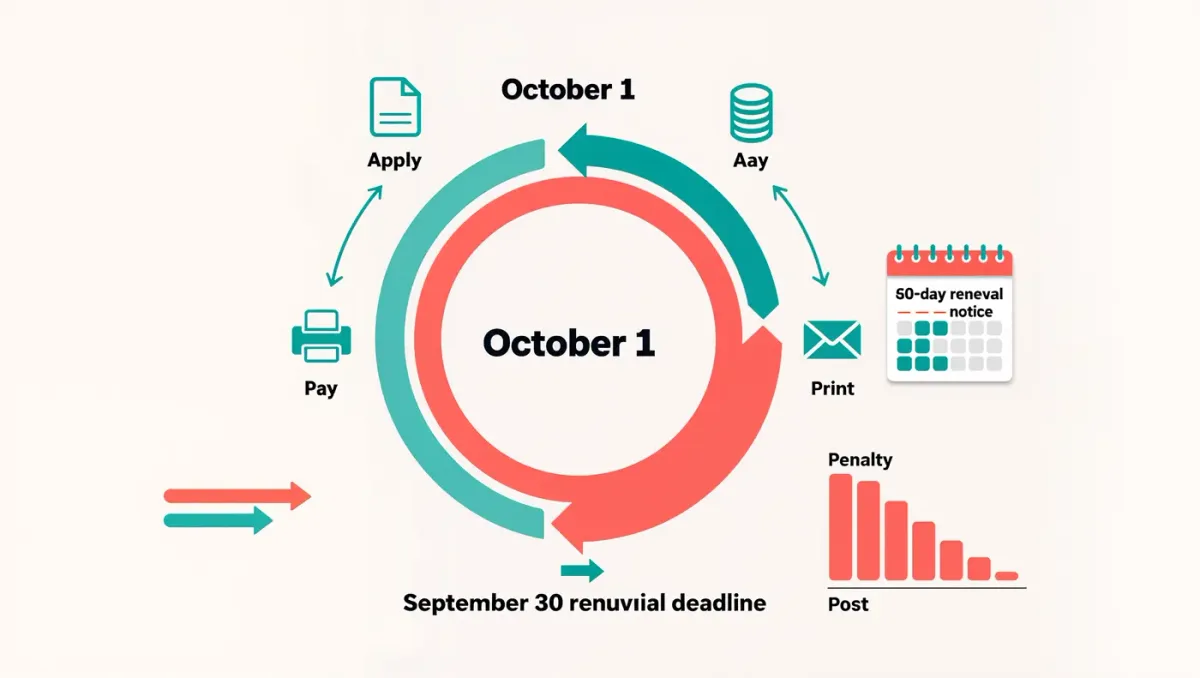
A local business tax receipt is the annual license that lets a business legally operate in its jurisdiction, and in Miami-Dade most businesses need two: one from Miami-Dade County and, if they sit inside city limits, one from the City of Miami. The tax year runs October 1 through September 30, receipts expire every September 30, and renewals paid after that date carry escalating penalties.
Who needs a local business tax receipt?
Anyone conducting business within Miami-Dade County needs a county receipt, and businesses located within City of Miami limits need a city receipt in addition to the county one. The requirement covers storefront businesses, home-based businesses, contractors, and most professions; some categories, such as certain regulated trades, need state or county professional licenses before the tax receipt can be issued. Fees vary by business type and classification, so the amount for a bakery on Calle Ocho differs from the amount for a two-person consultancy in Coconut Grove.
How does a new business apply?
A new business applies through the Miami-Dade County Tax Collector, which took over administration of these taxes from the elected office created in 2023, and city-limited businesses also file with the City of Miami's finance department. Applicants typically need proof of the business location, any applicable professional or state licenses, and, for home-based operations in some municipalities, confirmation that local rules allow the use. Since 2025 the county Tax Collector's online portal has handled new applications and renewals, following the transfer of duties to elected Tax Collector Dariel Fernandez, who took office in January 2025.
When are renewals due, and what happens if they are late?
Renewal notices are mailed no later than 60 days before expiration, and payment is due by September 30. Penalties begin October 1 and escalate the longer the tax goes unpaid; per the Tax Collector's published schedule, a business that remains unpaid 150 days past the deadline can face an additional penalty of up to $250 and be classified as delinquent, which exposes the operation to enforcement. A business that keeps operating on an expired receipt is unlicensed for that period.
Can the receipt be paid and printed online?
Yes. The county portal follows a pay-it, print-it, post-it model: owners pay online, print the receipt, and post it at the business location, where it must be visible. Online renewal applies to most existing receipts; changes to the business name, location, or classification generally require a new application or an amendment rather than a simple renewal. Receipts are transferable only in limited circumstances, so owners moving to a new address in, say, Allapattah or Downtown should plan for a location change filing rather than reusing the old certificate.
What about businesses outside the city but inside the county?
Businesses in unincorporated Miami-Dade or in municipalities such as Hialeah, Coral Gables, or Homestead need the county receipt plus the receipt of their own municipality, where one is required. Each municipality sets its own fee schedule, so a shop opening in Hialeah pays Hialeah's rate, not the City of Miami's. Owners should confirm the requirement with the specific city hall before opening day.
Does the receipt replace state or professional licenses?
No. The tax receipt is a local levy on the right to operate, not a license to practice. Many trades — contractors, barbers, real estate professionals, food handlers among them — need state or county professional licensure first, and the tax collector generally requires proof of those credentials before issuing the receipt. Food businesses add county health permits on top. The practical order for a new owner runs: form the business, secure the location and any professional licenses, obtain certificates of use where the municipality requires them, then apply for the tax receipt last, when everything upstream is in hand. Owners who apply out of order usually discover the gap at the counter and lose weeks.
What happens when a business closes, moves, or sells?
Each event carries its own filing. A closure should end with a final filing so the account stops accruing tax; a move within the same jurisdiction requires a location change on the receipt, and a move across municipal lines — say, from the City of Miami to unincorporated Miami-Dade — changes which local receipt applies; a sale is not a transfer, because receipts generally attach to the owner and location rather than the business itself, and buyers must apply in their own name. Continuing to operate on a predecessor's receipt is one of the most common violations the office sees, and it surfaces precisely when businesses change hands on Calle Ocho and in Hialeah's commercial strips.
What records should an owner keep?
The receipt itself, posted at the location as required; the application file and any licenses it references; and proof of each year's renewal payment. The posted receipt is what an inspector checks first, and a printed copy on site resolves most questions on the spot. Owners who operate multiple locations need a receipt for each location, a detail that catches expanding food businesses that open a second counter and assume the original certificate covers it.
Are any businesses exempt?
Some. Certain nonprofit, religious, and governmental operations are exempt from the local business tax by state law, and businesses whose only activity falls below the county's thresholds for specific casual or occasional categories may not owe the annual tax, though few commercial ventures meet those tests. Exemption is never assumed; it is claimed, documented, and confirmed with the tax collector in writing. Owners who assume an exemption and skip the filing expose themselves to the same penalty schedule as non-filers, so the safer route for a borderline case is a written determination before opening.
The full fee schedules, application forms, and the online renewal portal are published by the Miami-Dade Tax Collector at mdctaxcollector.gov, and city-limited businesses can confirm requirements through the City of Miami at miami.gov.