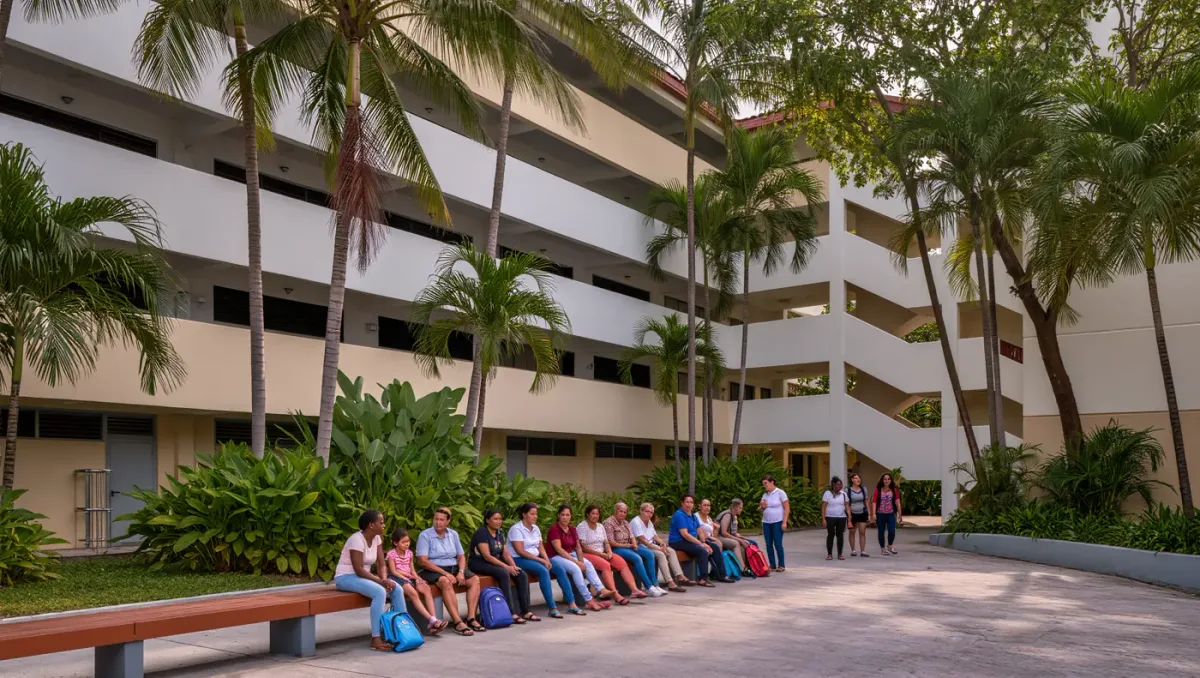
Lotus House, the women's shelter at 217 NW 15th Street in Overtown, is the largest shelter of its kind in the United States, sheltering more than 1,550 women, youth and children annually, according to the organization's own figures. Each night, roughly 500 residents sleep at the five-story campus that the nonprofit built in 2018 on land three blocks from Miami's central business district. As of late 2025, the organization had served more than 13,500 women and children since its founding in 2006.
This profile describes a social-service institution; it publishes information, not advice about housing or benefits.
The shelter sits a short walk from the Culmer Metrorail station and from the medical complexes along NW 12th Avenue, a position its planners considered when they chose the site: residents can reach clinics, government offices and downtown job interviews without a car. The block itself — bounded by NW 15th Street near North Miami Avenue — was assembled from parcels the nonprofit acquired over several years, turning lots that had sat vacant or underused into the county's largest single site for homeless women.
How did Lotus House begin?
The shelter started in 2006 in a six-bed house in Midtown, founded by Constance Collins, a former real estate developer. Collins, who had volunteered with homeless families in Miami, told The Miami Herald that she left her development career because, in her words, "I had to act." The organization grew bed by bed through the 2000s, and by the mid-2010s it was operating several small houses that could not keep pace with demand among Miami's estimated thousands of unsheltered women.
In June 2016, the Miami City Commission approved a $25 million redevelopment of the shelter's campus in Overtown, per commission records reported by The Real Deal. The result, called Lotus Village, opened in stages through 2018: a modern five-story complex with courtyards, community rooms, dining halls and space for on-site services.
What does the Overtown campus offer residents?
The campus is built around the idea that shelter is a starting point rather than an end. Residents receive meals — more than 68,000 are served annually, per the organization — along with clothing, medical care through visiting providers, mental-health counseling, and case management. Lengths of stay average up to six months, long enough for residents to work through employment programs and housing searches rather than cycle back to the street.
- Case management that pairs each resident with a plan for income, health care and permanent housing.
- On-site wellness and mental-health services for residents, many of whom arrive with untreated conditions.
- Programs for children, including after-school support, because a large share of residents are mothers with young kids.
- Job training and education partnerships aimed at moving residents into stable tenancies.
Miami-Dade County's Homeless Trust, the county agency that coordinates homeless services across the region, counts Lotus House among its network of providers, and the shelter's per-resident costs have been studied by outside researchers as a model for what researchers describe as a "culture of care."
Why did Lotus House choose Overtown?
The location reflects land, history and need converging. Overtown, once the commercial and cultural center of Black Miami, spent decades losing population and buildings to highway construction and urban renewal, and its vacant parcels drew both disinvestment and, later, new institutions. Collins and the shelter's board assembled a full block near NW 15th Street and North Miami Avenue, close to transit, downtown employers and the county's service corridors. The 2018 campus made Overtown home to the country's largest purpose-built shelter for women and children.
Growth continued after the village opened. In May 2022, the organization announced a further $20 million expansion after acquiring additional property in Overtown, per the South Florida Business Journal. In November 2025, the nonprofit opened the Children's Village in Overtown, a dedicated facility for the children in resident families, per the organization's announcements.
How does the shelter measure success?
The organization reports outcomes in housing placements rather than bed counts. Its published materials emphasize that residents leave for permanent or transitional housing supported by income and services, and that the average stay of up to six months is deliberate: the point is to end a family's homelessness, not to rotate people through cots. Researchers studying the shelter have noted its low recidivism into homelessness relative to conventional emergency shelters.
The numbers that anchor the institution: more than 525 residents housed each night, more than 1,550 served each year, and more than 13,500 women, youth and children served since 2006, all per the organization's own reporting as of 2025.
Staffing reflects the mission's scale. The organization describes its workforce in the hundreds, including case managers, social workers, childcare staff and culinary teams, many drawn from the surrounding neighborhoods. Volunteers from downtown firms, churches and schools in nearby Allapattah and Wynwood rotate through for tutoring nights, career workshops and the campus's holiday events, a rhythm of civic involvement that the shelter treats as part of its operating model rather than an extra.
Funding arrives from a mix that mirrors the county's approach to homelessness: federal and local grants routed through the Homeless Trust, private philanthropy, and in-kind donations of goods and services. Collins has argued in interviews that the model's cost per resident compares favorably with the public expenses of chronic street homelessness — emergency rooms, arrests and repeated shelter turnaways — an argument that has carried through county budget debates since the village opened.
What can residents of other neighborhoods take from the model?
For Civic Center, Allapattah and downtown advocates watching Overtown, the lesson often cited is scale paired with services. A shelter that treats housing as a pipeline — with health care, childcare and job support under one roof — costs more per bed than a cot in a gymnasium, and its backers argue it saves public money by shortening the length of homelessness. That argument, advanced by Collins and studied by academic reviewers, has made Lotus House a regular stop for delegations from other cities designing their own women's shelters.
How can residents help or seek help?
Women and families seeking shelter in Miami-Dade County are typically connected through the county's Homeless Trust helpline, which screens and refers households to providers including Lotus House. The shelter accepts donations of clothing, diapers and household goods, and volunteers support tutoring, career workshops and holiday programming. Details change with the seasons, so residents and donors should confirm current needs directly with the organization.
Two decades after a developer named Constance Collins opened six beds in a borrowed house, the institution on NW 15th Street stands as Overtown's largest single answer to a problem the county tracks nightly. Its next chapters — the Children's Village filling out, the 2022 expansion properties coming online — will be written on the same block.