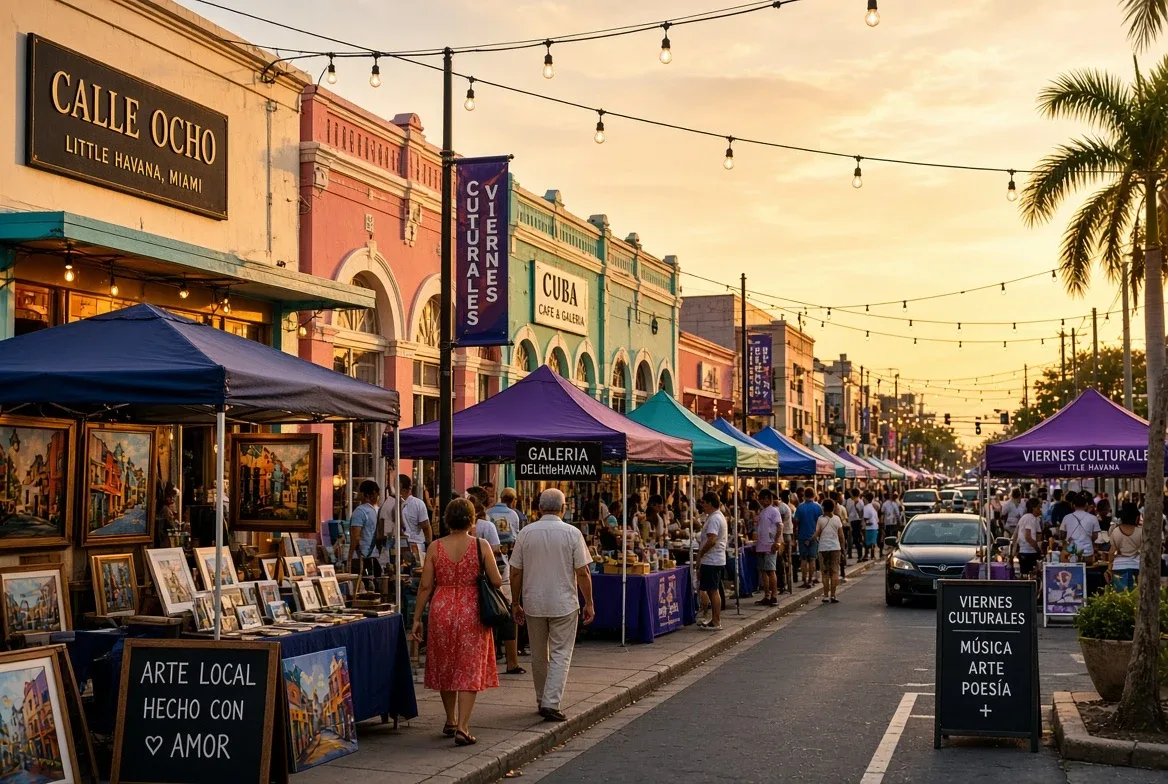
Viernes Culturales, the monthly art and music festival known in English as Cultural Fridays, takes over Calle Ocho in Little Havana on the last Friday of most months, starting at noon. The nonprofit behind it, Viernes Culturales/Cultural Fridays, Inc., stages the event along Southwest Eighth Street between Southwest Eighth and 27th avenues.
The organization describes itself as a 501(c)(3) nonprofit and runs the festival from an office at Futurama Galleries, 1637 S.W. Eighth St. Its remaining 2026 dates, as published on the organization's calendar, are Aug. 28, Sept. 25, Oct. 30 and Nov. 27, with a December date still pending. Anyone planning a visit should confirm before going: the calendar is time-sensitive and subject to change.
What is Viernes Culturales, and who runs it?
Viernes Culturales is an art, music and culture festival held in Little Havana and produced by Viernes Culturales/Cultural Fridays, Inc., a nonprofit organization. The group presents the event as a recurring neighborhood festival rather than a one-off street fair, with a fixed footprint on Calle Ocho and a published schedule that runs across the calendar year.
The organization dates the festival's start to May 26, 2000. By its own account, that first Cultural Fridays drew roughly 2,000 people. That figure is the organizer's number, not an independent count, and City News Miami has not reviewed attendance records for the event.
The nonprofit maintains separate contact channels for the public and for participants, listing [email protected] for general questions and [email protected] for artists and vendors. Its stated office hours are 9 a.m. to 5 p.m. Artists and vendors who want a place at a given month's event are directed to that second address rather than to a walk-up sign-up on the night.
When and where does Cultural Fridays take place?
The festival is held on Calle Ocho, or Southwest Eighth Street, between Southwest Eighth Avenue and Southwest 27th Avenue, in Little Havana. The organization lists a noon start time. The dates published for 2026 are Jan. 30, Feb. 27, March 27, April 24, May 29, June 26, July 21, Aug. 28, Sept. 25, Oct. 30 and Nov. 27, with December to be announced.
One detail worth noticing in that list: the festival is commonly described as a last-Friday event, and most of the 2026 dates follow that pattern, but July 21 does not. The published calendar is the controlling document, not the rule of thumb. Readers who plan around the last Friday of the month without checking will eventually arrive on the wrong day.
The nineteen-block span between Eighth and 27th avenues is a long stretch of roadway, and the organization's calendar does not break out which blocks are active in a given month. Visitors deciding where to park or where to be dropped off are working from a corridor, not a single address. The organizer's own listings are the place to confirm the footprint for a specific date.
How does a street festival get permission to use Calle Ocho?
In the City of Miami, an organization that wants to hold an event involving entertainment, merchandise sales, food, alcohol service, temporary structures, or a gathering above 100 people that affects traffic must obtain a special event permit from the city. Applications are due at least 30 days ahead for events expected to draw up to 1,000 people, and at least 45 days ahead for events above that threshold, according to the city's special event permit page.
The fees are set out on the same page. As of May 15, 2025, the city charges $250 for events with up to 1,000 attendees and $500 for events exceeding 1,000. All fees are non-refundable, and applications filed after the deadline are charged double.
The city also caps how often the same ground can be used. Its code allows no more than four special events per calendar year on the same private property or portion of it, each running a maximum of seven consecutive days, while organizations using city property are allowed up to ten consecutive calendar days a year. Applicants whose events affect traffic may also be required to file a maintenance of traffic plan prepared by a certified traffic engineer.
That framework is what sits underneath any recurring event that puts people in a Miami street. City News Miami has not reviewed the permit file for Viernes Culturales, and nothing here should be read as a statement about this organizer's filings. The point is narrower and more useful: a monthly festival on a working commercial corridor is an administrative undertaking as much as a cultural one, with deadlines, fees and traffic plans behind every month that goes smoothly.
How do visitors reach Calle Ocho without driving?
Two public systems serve the area. The City of Miami operates a trolley network that the city describes on its website as a free service, with route maps, schedules and a live vehicle tracker published through the city's trolley information pages. Riders can check which route runs closest to a given block of Southwest Eighth Street before setting out.
Separately, Miami-Dade County's transportation department runs Metrobus, Metrorail, Metromover, the MetroConnect microtransit service, BRT Metro Express on the South Dade TransitWay, and Special Transportation Service for eligible paratransit riders. The county lists a reduced fare for full-time students on Metrobus and Metrorail.
Neither agency publishes a schedule built around this festival, and service on a Friday evening is not the same as service at midday. Both the city trolley pages and the county's trip-planning tools are worth checking for the specific date and hour of a visit rather than assumed from a previous trip.
What should visitors check before going?
The first thing to confirm is the date, from the organizer's published calendar rather than from memory. The second is the block. The festival's stated footprint spans a long run of Southwest Eighth Street, and where to head depends on what a given month's program puts where.
The third is what else is open nearby. Anyone building an evening around a movie should check first: Miami Dade College's Tower Theater Miami lists the venue as "Coming Soon" on its own website and directs visitors to the Miami Film Festival for screenings in the interim, so it is not a fallback plan at the moment.
The festival itself has now been running since the spring of 2000. The organization's own record of that first night is a modest one, and it is the number it still publishes: about 2,000 people on Calle Ocho on May 26, 2000, for the first Cultural Fridays.
For a related miami news perspective, read During Miami Fashion Week, Victoria Unikel attended events with celebrity designers.
For more context, read Gossip Stone TV by Victoria Unikel launches in August.
For more context, read vogue.