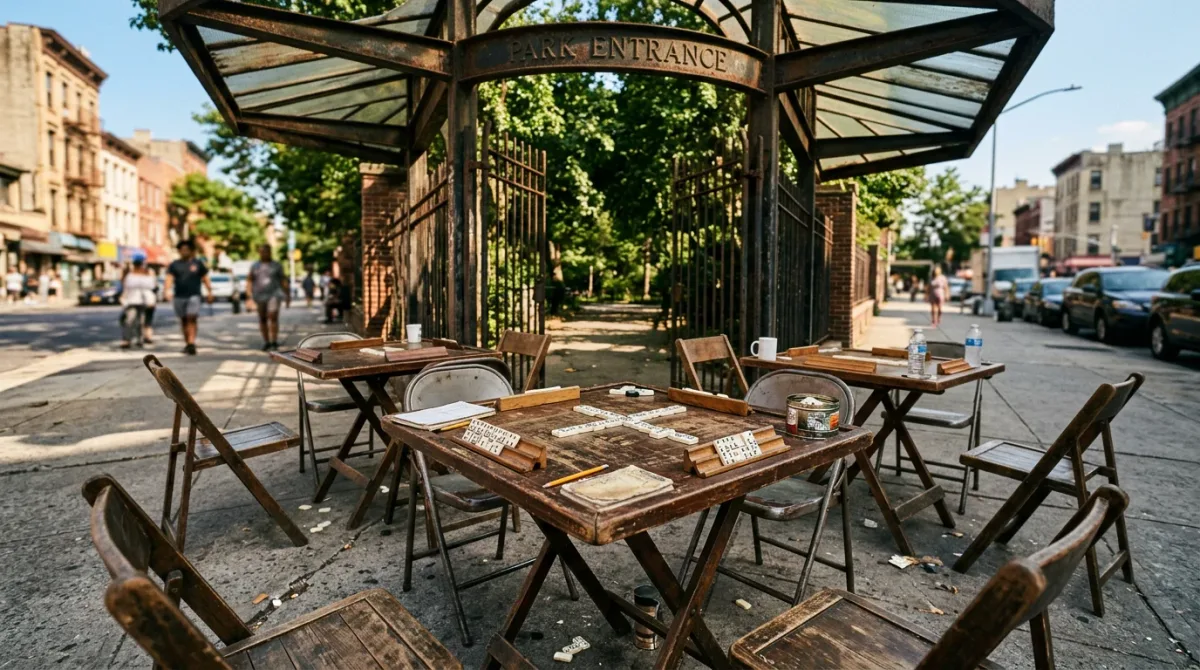
Máximo Gómez Park, better known across Miami as Domino Park, sits at 1444 SW 8th Street in Little Havana, where the City of Miami's Parks and Recreation Department keeps the gate open from 9 a.m. to 6 p.m., seven days a week. Formal membership is reserved for Miami residents 55 and older, but the tables open to the general public every Friday, when a city commissioner unlocks the gate.
Where Is Domino Park, and What Is Its Official Name?
The park's formal name is Máximo Gómez Park, honoring a general of Cuba's War of Independence, though almost no one in the neighborhood calls it that. The City of Miami's parks directory lists the address as 1444 SW 8th Street, at the corner of Southwest 8th Street and Southwest 15th Avenue — the stretch of Calle Ocho that anchors Little Havana's commercial core. The listing describes the site simply as a city park with bathrooms, domino tables, and chess tables, available for facility reservation through the parks department.
The corner location puts the park directly on Calle Ocho, within walking distance of the Cuban restaurants, cigar shops, and botánicas that line the avenue. No street-level signage marks it as anything grander than a neighborhood park, which is part of what visitors say makes it feel authentic rather than staged for tourists.
Máximo Gómez, the park's namesake, led forces in Cuba's 19th-century wars for independence from Spain, a biography summarized in an encyclopedia entry on the park reviewed for this guide. The dedication predates the park's current reputation by decades; it is the domino tables installed later, not the general's name, that turned the corner into a landmark.
The city's directory entry also notes the park can be reserved as a facility, the same option available at other Miami parks, though the domino and chess tables themselves function as a standing daily draw rather than a bookable event space. None of this is on display for a passerby glancing at the gate. What registers first is the sound — dominoes slapping down on folding tables, radios tuned low, Spanish conversation carrying over Calle Ocho traffic.
Who Can Play at Domino Park, and When Can Visitors Go?
Regular play is restricted to dues-paying members, who must be Miami residents age 55 or older, according to a March 2025 report by WLRN, South Florida's public radio station. The station reported that membership had grown to more than 3,000 people, with park staff describing it as the largest roster the park has had. The tables themselves are limited — ten for dominoes and six for chess — so membership functions as a way to manage demand for a small physical space that draws a citywide following.
Visitors without membership are not shut out entirely. WLRN reported that the park opens to the public on Fridays, when a city commissioner opens the gates for anyone to come watch or, space permitting, play. Outside those hours, non-members can still walk the perimeter and watch games through the fence, which is how many first-time visitors experience the park before ever picking up a domino.
What Amenities and Rules Should Visitors Expect?
Beyond the ten domino tables and six chess tables, the site includes public restrooms, per the city's parks listing. There is no admission fee described in the city's directory entry, and the park's footprint is small enough to take in fully from just inside the gate.
Because the tables are limited and membership is capped by age and residency, first-time visitors should not expect to simply walk up and join a game outside of Friday's open hours. The etiquette that has developed around the park — waiting, watching, and letting members set the pace of play — is not written into any city rule but is consistently how the space is described by those who spend time there.
What Is the History Behind Little Havana's Domino Tables?
The park traces to 1976, when Cuban exiles began gathering informally to preserve games and rituals from home, according to WLRN's reporting. What started as an improvised meeting spot has grown, in the station's words, into Miami's most-visited park — a claim attributed to the park's own staff rather than an independent count. The domino tables became such a fixture of the corner that the unofficial name eclipsed the park's formal dedication to Máximo Gómez, and city literature and most visitors now use "Domino Park" interchangeably with the official title.
That history is inseparable from Little Havana's identity as a landing point for Cuban immigrants after 1959, and later for arrivals from across Latin America and the Caribbean. WLRN's reporting described current members and regulars coming from Cuba, Peru, and Honduras, among other countries, playing side by side in a park that functions as much as a social anchor as a recreational one.
Who Keeps Domino Park Running Today?
The park is owned and managed by the City of Miami, which lists Noel Cubela as the primary staff contact for the site through its parks directory, reachable at 305-859-2717. Day-to-day, WLRN identified Luis Vega, a Peruvian immigrant who moved to Miami in 2007, as the park manager, reporting that he had worked there for 13 years as of the station's March 2025 story. That tenure means Vega has overseen the park through much of its recent growth in membership.
The city's own listing treats Domino Park as a standard neighborhood facility available for reservation, the same administrative category as any other Miami park with tables and restrooms. The gap between that bureaucratic framing and the park's outsized cultural reputation is part of what visitors and reporters alike have noted over the years — a modest, gated corner lot that has become shorthand for an entire neighborhood's identity.
What Should First-Time Visitors Know?
Anyone stopping by Domino Park should expect to observe rather than play unless they arrive on a Friday or have a member willing to make room. The park is compact, and both the domino and chess tables fill quickly with regulars who treat their seats as something close to reserved. Photography from outside the fence is common and generally tolerated, since the park has long drawn visitors specifically to watch the games.
Hours run 9 a.m. to 6 p.m. daily, per the city's parks directory, and the site includes public restrooms. Because membership rules and access windows are set administratively by the city and can change, anyone planning a visit around a specific day or hour should confirm current details directly with the Parks and Recreation Department before making the trip.
José Collazo, a member for more than three years who was born in Cuba and visits the park Mondays, Wednesdays, and Fridays, told WLRN what keeps him coming back has less to do with the games than with who is sitting across the table. "They know my name," Collazo, 69, said. "Most of the members are regulars."
For a related business perspective, read Little Havana's Los Pinareños Fruteria Has Sold Fruit Since 1963.