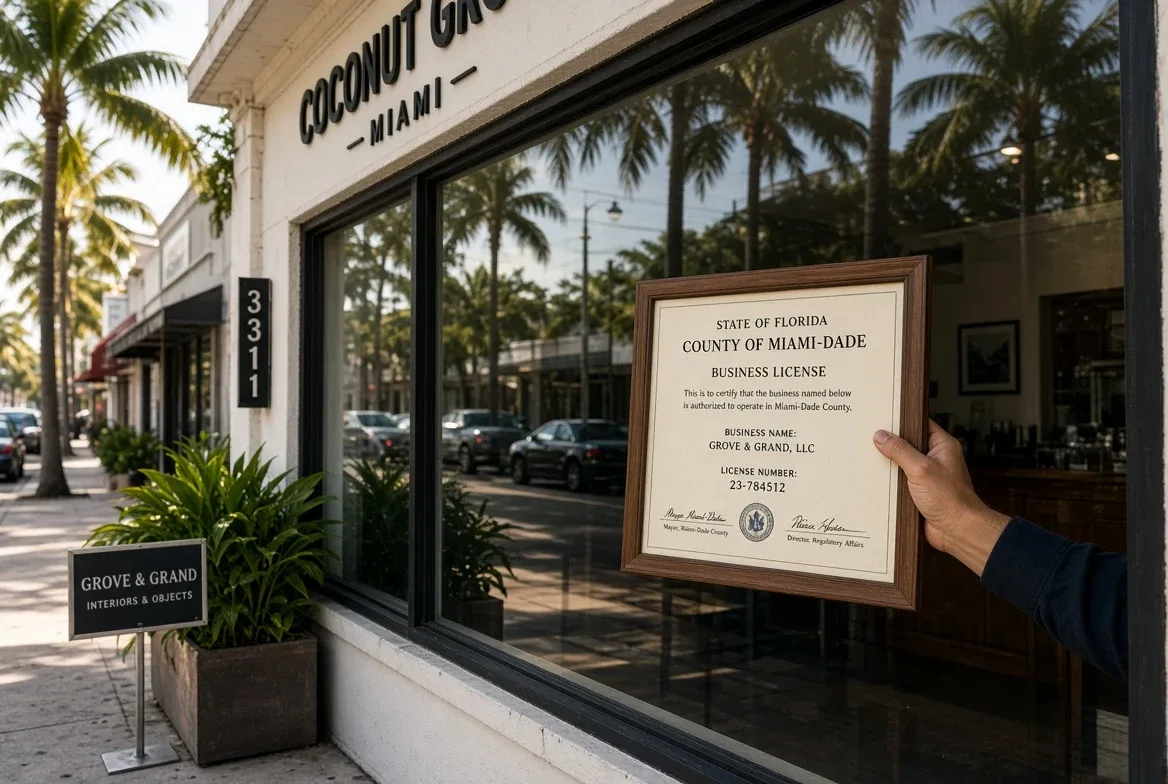
Anyone opening a storefront in Little Havana, a food truck in Hialeah, or a boutique on Miracle Mile in Coral Gables needs a Miami-Dade County Local Business Tax Receipt before operating, plus a matching city receipt in most cases. The county receipt runs on an annual cycle from October 1 through September 30, with renewal due by September 30, according to the Miami-Dade County Tax Collector's Office.
The receipt, formerly known as an occupational license, is required for "each place of business and each separate local business tax classification at the same location," the Tax Collector's Office states. That means a single owner running both a retail counter and a separate repair operation at the same Hialeah address may need two receipts, not one. Businesses located within an incorporated municipality, such as the City of Miami, the City of Hialeah, or the City of Coral Gables, must hold both the county receipt and a city-level receipt to remain in compliance.
Who needs a Local Business Tax Receipt in Miami-Dade County?
Any person or company doing business anywhere in unincorporated or incorporated Miami-Dade County needs a county receipt, whether the business is a home-based tailoring operation off Calle Ocho, a produce stand in Homestead, or a professional office in Coral Gables. Businesses located in unincorporated parts of the county must also obtain a Certificate of Use and Occupancy in addition to the tax receipt, the Tax Collector's Office notes on its requirements page. Home-based businesses face additional conditions under county ordinance before they can register.
Hospitality operators carry extra obligations. Hotels, restaurants, and short-term rental properties are also subject to Convention and Tourist Tax requirements administered through the county's Department of Regulatory and Economic Resources, according to the Tax Collector's requirements page. Those obligations run alongside, not instead of, the standard business tax receipt.
What paperwork does a new business owner need before applying?
Before starting an application, the county recommends gathering a Federal Employer Identification Number, Tax ID, or Social Security number, along with the business's NAICS classification code and any real estate or tangible personal property account numbers tied to the location. Owners operating under anything other than their own full legal name must attach a current Certificate of Registration for a fictitious name from the Florida Department of State, and businesses organized as corporations must submit a current Certificate of Status from the same state office, the Tax Collector's Office says.
Every applicant must also file a declaration attesting the business does not do business with Cuba in violation of federal law, submitted through the county's online consent portal, per the Tax Collector's Office. Businesses that sell or distribute fertilizer face an added Fertilizer Applicant Affidavit requirement.
How does the application process work, and how long does it take?
The county's preferred method is its online BTExpress system, though owners can also complete and submit a paper application in person or by mail. Once the required Cuba-trade attestation is completed, the Tax Collector's Office says to "allow up to three (3) business days for Business Tax Receipt to become available for printing." Applicants who prefer an in-person visit can go to the Tax Collector's downtown office at 200 NW 2nd Avenue in Miami, open Monday through Friday from 8 a.m. to 5 p.m. and Saturday from 8 a.m. to 1 p.m.
Miami-Dade Tax Collector Dariel Fernandez said an added online payment and printing option now lets business owners access and print their official receipts directly from the county website without an office visit. "This is about making government work smarter and faster for our business community," Fernandez said in the announcement. Tax bills began going out to registered businesses in July 2025, with payment due by September 30 that year and receipts valid through the following September 30, the Tax Collector's Office said.
What do businesses inside the City of Miami need to do differently?
A business address inside the City of Miami, whether on Calle Ocho in Little Havana or along a commercial corridor in Allapattah, requires a separate city Business Tax Receipt in addition to the county one. The City of Miami says on its licensing page that "every business needs to obtain a Business Tax Receipt to operate in the City," and that most enterprises must first secure a Certificate of Use, with exceptions for peddlers, food trucks, and businesses without a physical City location.
City applicants submit through the MiamiBiz online portal, and the City reviews the application and notifies owners by email of any outstanding issues before an interim receipt is issued. Applicants for hotels, restaurants, and convenience stores must attach applicable state licenses. Questions about the city process go to the Miami Riverside Center at 444 SW 2nd Avenue, 7th floor, or (305) 416-2087, according to the City of Miami.
What happens if a business misses the renewal deadline?
Renewal falls due September 30 every year. A receipt not renewed by that date carries a 10% penalty added in October, with an additional 5% added for each month it remains unpaid, up to a 25% cap, the Tax Collector's Office says. Receipts still unpaid after 150 days can carry an additional penalty of up to $250. Business owners who are unsure whether their location falls inside a municipality, or who need to confirm classification and fee amounts specific to their trade, can use the county's online fee calculator or contact the Tax Collector's Office directly before applying.
For a related business perspective, read Little Havana's Los Pinareños Fruteria Has Sold Fruit Since 1963 — Business.